|
5. CITIZEN SOCIOLOGY, ANALYSIS OF CRIME
What is anthropography? You have also recently referred to a citizen sociology, and so in what respect does that apply?
UPDATE 2010
Introduction
Anthropography is the designation I gave to my project in citizen philosophy as formulated in my early work Meaning in Anthropos, written in 1984 but published seven years later. The sub-title was Anthropography as an interdisciplinary science of culture. I fully accept the provisional and preliminary nature of that thesis. The word anthropography is generally used in reference to the geographical distribution of mankind. I applied some extended meanings and reference points.
Anthropography conventionally amounts to ethnography, linking to anthropology. My citizen usage of the term anthropography should not be confused with anthropology, which is one branch of social science. Citizen anthropography made inclusive gestures towards all the three main branches of social science, meaning psychology, anthropology, and sociology. The citizen version represents an endeavour to see things in the round, along with other disciplines such as the history of religion. I have also described this commitment in terms of philosophical anthropography, meaning a philosophy of culture.
In 1984, I established at Cambridge the project known as IRCA (Intercultural Research Centre of Anthropography). This continued for several years as a focus for liaisons and publications. That project did evoke some liberal academic attention, even being approached by persons wishing for publication of their doctoral theses. I did not have any official funding, so I was unable to branch out as some people suggested. My basic purpose was study and formulation, not promotion or organisation.
Furthermore, I left Cambridge for Scotland, where I became a resident during the 1990s. One reason for this move was that I disliked city life, then becoming increasingly oppressive in Britain. Crime was on the increase, and Cambridge became an overspill for London. Cambridge was rapidly changing character in certain respects. A basic decision of mine was to reorient in philosophy outside a library milieu, which although formerly helpful to me, had also become static in some ways.
I spent many happy days at CUL (Cambridge University Library), combing through many of the learned journals stocked there in such abundance, a project which included the “dead” (terminated) journals also. However, the antiquarian dimensions of such an activity have to be complemented by more immediate “fieldwork” and real life experiences.
5.1 The British Yob
I was often fascinated to ascertain, for instance, what contemporary scholarship and social science made of ancient religion or remote tribal communities. Yet everyday realities outside the library were very stark by comparison. In 1980s Cambridge, the proliferating yob phenomenon was becoming evident. The word yob generally denoted a bad-mannered or aggressive male teenager (with the early 20s age group also being implied). This category frequently became thieves.
Areas of the city which had formerly been safe and tranquil were now subject to burglaries and violence. Local people said that in some streets, nearly every house had been burgled. The yobs watched sick American videos and frequently took drugs. The older generation regarded them as a mindless blight. Violent gangs and marked antisocial behaviour now made their appearance in a more intensive way than ever before.
At one Cambridge street where I lived during the early 1980s, a group of punks moved in, creating havoc amongst neighbours with their antisocial attitudes. The police had to be summoned to monitor the situation. The leader of the refractory pack was a middle class 18 year old. He was in no financial want, having a well paid job and living in the comfortable house of his absent father. He had acquired the sense of aggression fashionable in the pop music world, where Sid Vicious had become an unmerited hero. Decadent pop stars and video nasties were too often the role model for yob shortcomings.
5.2 Citizen Sociology as Sociography
Reflection upon such matters led me to conclude that the educational system in many schools was breaking down. I was dissatisfied with sociology; this science was too remote from everyday concerns. The politicians were permanently on holiday, while many academics were insulated from the social dysfunction that was accelerating. The obscured ecological factor was peripheral at this stage; climate change was not taken seriously in intellectual circles. The most obvious problem was a major inventory of social maladies whose causes were too often ignored.
Eventually I described such reflection and analysis as “citizen sociology,” a phrase I first used in Some Philosophical Critiques and Appraisals (2004), p. ix. “Citizen sociology is of amateur status and does not claim to be expertly scientific, but merely to address in a critical spirit pressing matters requiring attention.” I have also use the associated word sociography in this respect; again no ultimate definition is claimed. Much of the contents of the Citizen Initiative website can be related to sociography. Many of the chapters in my Pointed Observations (2005) also have a bearing upon this approach. Social criticism is an alternative designation. See also Aspects of Citizen Philosophy.
5.3 The Skinhead Trends
The predecessors of punks were the skinheads, who became visible in the late 1960s and early 1970s. They are sometimes perceived as an offshoot or rival of the mod contingent, noted for a fastidious attention to fashion clothing. Early photographs of the 1960s skinheads assist to differentiate them from the later waves. A well known photo of a skinhead group in Piccadilly reveals young men who resemble typical working class Londoners. They are wearing sleeve and collar shirts, braces, jeans, and working boots. Their hair is short, but not close-cropped; they also exhibit sideburns. They could easily seem a more attractive option than the contemporary hippies, whom they derided.
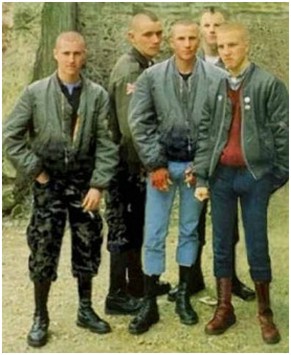
So what went wrong? Later the boots got higher, the hair became closely shaven, the profile became more aggressive. Some say that early skinheads were asserting the working class lifestyle of their fathers. This factor seems relevant, but if so, the "ideal" broke down, because the fathers never did what some of the offspring deviated into.
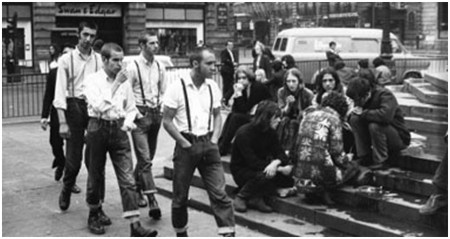
Early skinheads in Piccadilly
The famed skinhead boots became a symbol of the pack. Laced boots of the Doctor Marten type gained ascendancy as standard regalia, the steel-capped variety being frowned upon by policemen and noted for causing damage at football matches. The steel-toed boots were called bovver boots in the 1960s, the word bovver deriving from the Cockney pronunciation of bother (meaning aggravation or violent behaviour). Such footwear was dangerous in fights. Football hooliganism became an extension of the skinhead presence. In London, some pugnacious skinheads commenced the infamous practice of “Paki bashing.” Pakistanis and other South Asian immigrants dreaded the sight of skinheads. Political manipulation of skinheads by far right lobbying gained momentum during the 1970s. Racism was a very ugly feature of London life at this period. The National Front were pulling strings.
Skinheads liked reggae music and beer. In theory they were averse to drugs, associated with the long haired hippy lifestyle. Skinheads detested hippies. Yet some skinheads resorted to amphetamines and cannabis. Statistics are not available to ascertain the numbers involved. Many early skinheads were young manual workers. During the early 1970s, I was told that in some areas of London, skinheads had a habit of walking in a big pack across the width of a street, blocking anybody coming in the opposite direction. This was apparently the proof of “hard case” maturity. In Cambridge there were much smaller packs who kept to the pavement and who were wary of the police. Coppers (police constables) were still feared in those days.
The provincial skinheads did not like university undergraduates, who were mocked as being uselessly intellectual. Skinheads could be very pugilistic (especially after drinking beer or lager). Undergraduates were in danger on the streets at night. Cambridge skinheads were caricatured by the university population as mindless menaces. Intellectuals would say caustically that instead of the three R’s (Reading, wRiting, and aRithmetic), the skinheads had opted for the three B’s, meaning Beer, Birds (girls), and Bovver.
Later skinheads
There was a skinhead revival in the late 1970s. The permutations of this continued into the 80s and later. A new wave of teenagers gave fresh life to “skin” packs, who became notorious for football hooliganism and racist attitudes. The violent phenomenon of “Paki bashing” continued as a skinhead pursuit. The movement gained an extension in “neo-nazi skinheads,” who were widely criticised. Swastika symbols and tattoos became popular. The skinhead vogue developed into an international phenomenon, achieving a presence in America that puzzled and alarmed many onlookers. Some skinheads affirmed their resistance to the negative manifestations of this conglomerate movement. The category of anti-racist skinheads are sometimes known as SHARPs (Skinheads Against Racial Prejudice).
5.4 The Punk Vogue and Sid Vicious
Meanwhile, the punks had appeared in the mid-1970s. The punk trend emerged in London, from there moving out to the provinces. An American variant was also influential. In Britain, the punk dress code and general outlook was strongly influenced by the Sex Pistols, a rock band led by Johnny Rotten. In terms of stimulants and drugs, punks seemed to ingest (and smoke) whatever came along. They innovated short spiky hair, often dyed in streaks to look more outlandish. They identified with themes of alienation and anarchy.
Punks often regarded themselves as victims of the social system in all circumstances. Affluent pop stars encouraged the lack of due analysis. Pete Townshend of The Who made supporter comments concerning the punk vogue at a confused stage of his career, shortly before his alcoholism suffered the complication of addiction to cocaine and heroin. In contrast, critics said that punks were socially retrogressive, similar to the mods and rockers who had earlier caused trouble at seaside resorts.
Punks became noted for numerous bizarre hairstyles, including the Mohawk variety. The Nazi swastika was sometimes provocatively displayed on clothing, as if this made the owner more important or daring. The ill-fated Sid Vicious was a notable instance of this fetishism. He is strongly credited with authorship of the Sex Pistols song Belsen was a Gas, described by some commentators as a pun of "dark humour." Stronger criticisms can be made. Some of the lines read:
Belsen was a gas I heard the other day, in the open graves where the jews all lay
Life is fun and I wish you were here, they wrote on postcards to those held dear.
There were actually no gas chambers at Bergen-Belsen, a concentration camp in Germany during the Second World War. The inmates included Jews. More than 50,000 deaths occurred in this overcrowded camp, the victims suffering from malnutrition, disease, and mistreatment by guards. Some inmates were murdered by injections from SS doctors. Gas murders of millions occurred at six death camps, including Auschwitz and Sobibor. In addition, there were other horrors perpetrated on Jews by Nazis. The diabolical conditions at Auschwitz extended to a community of SS doctors who performed criminal experiments on prisoners, including women and children. The most notorious of these extremist practitioners was Dr. Josef Mengele, who murdered for dissection. "At Auschwitz, with full license to maim or kill his subjects, Mengele performed a broad range of agonising and often lethal experiments with Jewish and Roma (gypsy) twins, most of them children" (quote from article last linked). The significance of Nazi swastika is torture for many and death for millions, no matter how fashionable the Fascist symbol became amongst the punk wave and other trends.
At Auschwitz, the Nazi doctors injected victims with malaria and typhus, amputated healthy limbs, and deprived victims of oxygen. "The professional group that had the largest percentage of Nazi Party members was medicine" (Spitz 2005:xv). Killer medicine was not unique to the Nazis, a subject not for squeamish readers. The sinister SS medics inflicted artificial wounds which they infected with mustard gas, causing burns over the whole body, destroying organs and lungs. The plight of victims can scarcely be imagined by neo-Nazi punks and deniers of Holocaust. Whole legs were removed at the hips for transplantation to other victims. Experiments inflicting typhus killed 90 percent of victims. Epidemic jaundice experiments on Polish Jews caused many deaths, not to mention agonies.
Another pastime of depraved Nazi doctors was to freeze the bodies of victims in tanks of ice water, death occurring after three hours. Victims of the diverse experiments included many Jews, but others were also involved. For instance, Polish Catholic priests were deliberately wounded and then infected with gas gangrene and tetanus; ground glass and wood shavings were forced into the wounds by Nazi sadists. See further Vivian Spitz, Doctors from Hell: The Horrific Account of Nazi Experiments on Humans (2005).
Sid Vicious of the Sex Pistols
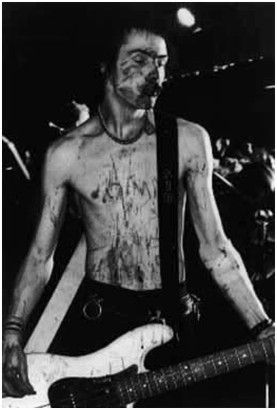
Sid Vicious (1957-1979) was a guitarist in the Sex Pistols, a British punk rock band who lasted for three years from 1975. His real name was John Simon Ritchie. The Vicious tag was part of the commercial hype aimed at the undiscerning audience who lionised him as a punk hero. One version says that he gained the extremist name because of an incident reported by the New Musical Express (NME) journalist Nick Kent. During a Sex Pistols gig at the 100 Club, Vicious hit Kent on the scalp with a rusty bike chain and drew blood. A friend of the victim was also hit by the chain-chipper. Kent suggests that this attack was the consequence of an amphetamine intake on the part of the aggressor. On that occasion also, an accomplice of Vicious pulled a knife. The NME report of Kent is dated December 1977 (formerly visible online).
In 1977, Sid Vicious encountered the American groupie Nancy Spungen, from whom he caught the heroin habit (though his mother is also implied in the damage at an earlier date). He became subject to suicidal tendencies. When Nancy saved him from jumping out of a third storey window, he repaid that mercy by bashing her head against the wall, until the blood from her scalp was a tangible wall decoration. He then broke into hysterical tears. This incident was reported by Nick Kent in Dec. 1977. Vicious is reported to have beaten Nancy on more than one occasion, perhaps even regularly. She covered up for his violence, attributing this to others.
The disconcerting temperament of this "constantly drunk" punk idol is evident in such reports as: Sid would strangle cats and slash himself with an old Heinz baked beans tin lid. He would cut himself to attract attention. The little boy lost played a dangerous game with his sanity. He cultivated a snarling image of violence; in one publicity video, he pulls a knife on an older passer-by. The Nazi swastika did not save him from disaster.
During a tour of America by the Sex Pistols in 1978, the psychological problems of Sid Vicious continued, both on stage and off. He cut on his chest, with a knife (or razor), the words “Gimme a Fix.” His predicament was attended by hospitalisation. Similarly dramatic was the eventual fate of Nancy, who died in October 1978 from a stab wound. Sid expressed conflicting versions of the event, including the admission that he stabbed Nancy. He was arrested, charged with murder, and let out on bail. Vicious afterwards tried to commit suicide, slitting his wrists and once more attempting to jump out of a window. Again he was hospitalised. He remained the primary suspect for Nancy's murder.
Sid Vicious was subsequently arrested for assaulting Todd Smith at a New York dance club. He was sent to Rikers Island jail for 55 days, undergoing an enforced and painful detoxication. On February 1st, 1979, he was released on bail. That same evening, he fatally resumed heroin intake, recklessly overdosing. He was dead the next morning, aged only 21. This violent and masochistic figure became a commercial punk icon, romanticised by rock star business for an uncritical audience. Nobody should wish to emulate him.
Anarchy in the UK (title of a Pistols song) was not the prettiest sight. The punk gang I was obliged to observe at Cambridge, in 1980-1, had some pronounced traits of aggression. They were identified as punks because of their aggregate hairstyle. I will here call their 18-year old leader Sturm, which may be taken as a pun on the German word for storm or assault. Sturm and his circle would revel in the nocturnal habit of constantly pulling a toilet chain in order to annoy the elderly couple next door. The victims complained that they could not sleep properly. To punk aggro, this meant that the social oppressors should invent a law against going to bed early. Punk rebels went to bed very late, a habit not to be questioned. Social workers attempted to reason with the Sturm gang, but could make very little headway with obdurate attitudes of the self-proclaimed victims of an oppressive social system. Sturm was not oppressed in any way; he enjoyed a decent wage from his office job, and even owned a car.
Sturm was host to an outrageous party one Saturday night. The noise level was high in that terraced street where I lived. Scowling punks sat on walls while drinking alcohol. Some guests were weirdo types who looked like drug freaks. The guests congregated in the street for hours. A few of them were observed to enter the gardens of neighbours in the early hours of the morning. Next day I found a hammerhead deposited in my garden, possibly a UK anarchist symbol of threat to ward off complaint.
When outnumbered, get reinforcements. The police were called in, and investigations were made. The situation was considered menacing by police authorities. Sturm’s wealthy father was contacted. The parent expressed horror at what was happening in his (second) house. Sturm was forbidden by pater to hold any more parties that could invite police attention. The paternal jurisdiction ended there. Pater could not fathom the punk attitude, and tended to avoid confrontation; all he had known in his younger days were 1950s teddy boys getting drunk on a Saturday night inside pub hours (and in those days all British public houses closed at 10.30 pm).
I had the opportunity to observe Sturm from an upstairs window when he was confronted by a neighbour. Michael, who was about thirty, complained that the noise in Sturm’s house was keeping his young daughter awake at the wrong hour. Michael had a mild temperament and was slow to anger, but now he became annoyed. Sturm came out into the street with an air of defiance. He said something like: “Don’t you crowd me, mate; I got my rights.” The worst punk mood amounted to: “If you don’t like what we do, that’s your damn fault; we hate the social system, so you just buzz off.” Sturm was tall, with a substantial physique. Michael was even bigger, with more muscle; he would not back down. Sturm must have realised suddenly that he was alone at the time. His friends were out elsewhere. The punk blustered, and then went back inside, scowling. He turned the noise down. Michael had won that round, but the gang would be back.
Numerous critics in Britain felt that punks represented the end of civilisation.
5.5 Paradise of the Far North Becomes Drug Problem Zone
By the end of the 1980s, many people in England felt that nowhere was safe from yobs. Some said that the Scottish Highlands represented the last outpost for peace of mind. When I first moved to the north of Scotland, local inhabitants testified to a social situation in which there was very little crime. The police felt quite confident and in control. I met people who insisted that nobody needed to lock their doors. This utopia was in contrast to the grim situation evident in the big cities of Edinburgh and Glasgow.
The northerly region from Inverness to Aberdeen was a paradise by comparison with the south. However, during the 1990s, crime infiltrated the Scottish towns and villages where formerly nobody had needed to lock doors or fit burglar alarms. The basic problem was the younger generation who resorted to drugs. A fatal support for this nationwide development occurred in 2004, when the British government relaxed the cannabis law.
In addition to the new social predicament was another local hazard, namely the Findhorn Foundation (located in Moray). This organisation sponsored Grof alternative therapy in their precincts until 1993, when an official recommendation, inspired by Edinburgh University, curtailed the problem in evidence. The very commercial enterprise called Grof Transpersonal Training Inc. was strongly associated with LSD “psychotherapy,” an illegal recourse promoted by some Stanislav Grof partisans. That activity acquired a controversial non-drug extension in Holotropic Breathwork; this temptation was legal and promoted in lucrative “workshops” by the Findhorn Foundation. The doctrines of Stanislav Grof are influential in "new spirituality" lore. The new age impresarios resented criticism of their activities, and stifled objections to their policies.
5.6 Manifestations of the Yob Psychology
In Great Britain, the descriptive national identity effectively devolved to Lax Britain in realistic terms. The absence of sufficient governmental regulations, against major forms of crime, endangered public safety. The deficit here includes the drug problem, aggravated by the official leniency towards cannabis during 2004-2008. The escalating crisis caused havoc in some schools where young cannabis users demonstrated the backward moods occurring in this form of “recreation.” The rescheduling of cannabis to Class B status in 2009 could not prevent adverse consequences of the Class C indulgence inaugurated in January 2004 by the Labour government.
The yob society in Britain developed a street drinking indulgence contributing to violence and harassment. The police reported a substantial increase in alcohol-related attacks by yobs. This phenomenon is also known as “under-age drinking.” Boys as young as seven participated in the vogue for cheap alcohol. The lack of parental care became glaringly obvious. The overstretched resources of an understaffed police force were a consequence of bureaucratic lunacy. The permissive society has been a failure in too many respects.
The ineffective nature of the criminal justice system in Britain was emphasised by such vocal groups as the Victims of Crime Trust, founded by a police officer (Shepherd, Pointed Observations, p. 114). Some magistrates have since taken a firm line with criminal behaviour; however, the general leniency towards burglary and other “minor” crimes remained very perturbing.
Yob defiance can be described as a contagious epidemic contributing to criminal behaviour. In the north of Scotland during the 1990s, I was able to observe teenage “hard cases” who swaggered about looking like the skinheads I had seen over twenty years before in Cambridge. Some Scottish fifteen year olds had very solid physiques. A very muscular manual labourer told me how he found one of these youths trespassing in his garden; he had to forcibly eject the intruder. I watched a yob trio in Forres try to light fires in bushes with matches. They would hoot at any passer-by with obvious defiance. I informed the police, who said they could do nothing without more concrete evidence of damage. At that period, three schoolboy yobs (aged 14-15,) in the far north, tied their female schoolteacher to a ceiling rafter. This was a gesture of contempt. They left her hanging precariously in a state of shock and terror.
Some commentators say that female schoolteachers cannot control thugs; the appropriate recourse is an ex-army supervisor with a birch rod who will exact appropriate punishments for every insolence. Learning is disdained by thugs; they repudiate the prospect with rejoinders like “shut yer face.”
Over the years I often visited Bournemouth, a holiday resort on the south coast of Britain. During the 1970s, the police were noted for their control in that city; incoming troublemakers like “rockers” would be sent on their way before they could commit any crime or disturbance. All this changed during the 1980s. By the 1990s, it was not advisable to leave a spare bike in an unlocked shed. Theft was rife, or so I was told by local inhabitants. In 2004, three yobs in the older age group entered the house of an elderly man and beat him brutally with baseball bats. This was clearly a premeditated act of the most violent and horrific type. The tragic victim was hospitalised with severe injuries. A public outcry ensued. Thugs like to victimise people much weaker than themselves.
The Clockwork Orange syndrome of violence became pervasive. Many years ago a very controversial movie was created by American capitalism. In Britain, that movie soon provoked strong complaints, underlined by the factor of “copycat” violence occurring in real life. This refers to the phenomenon of aggressors acting out an incentive derived from explicit visuals. Clockwork Orange (1971) contained a scene showing extreme violence and rape, a needless visual indulgence far removed from the priorities of any civilised taste. A real life incident was reported of criminals who wore, in imitation, the same costumes as the film characters. The offending movie was removed from circulation in Britain, remaining unavailable for nearly thirty years until the re-issue in 2000. That was the year after the producer Stanley Kubrick died. Clockwork Orange made many millions of dollars for Warner Brothers. Critics accused Hollywood of elevating profits above international wellbeing.
Another place I visited regularly, at one period, was the town of Langport in Somerset. Here in 2005 I was dismayed to find that a gang of yobs were in the habit of abusing a fine nineteenth century house on a main road passing through the town. That house was empty; the absent owner (who had several properties) was strangely indifferent to events. The yobs regarded the property as a recreation ground. They damaged the interior, and even tried to burn the place down (arson being a tendency of yobs). They were known to hurl objects from the windows at passing cars on the street below. Motorists were in considerable danger on such occasions. The nearest policeman was in another town some distance away; he could never arrive on time because of his many pressing engagements. Nobody stopped the yobs; nobody knew exactly what to do, although local feelings ran high against them.
I am glad to say that the police can be very effective in Somerset. A few years later, at another town in this county, a local publican was alarmed to find that a gun threat was in evidence during a quarrel arising on his premises. A gun was actually visible; apparently one round was fired. The police were informed of the problem; a helicopter quickly arrived, complete with several armed policemen who lost no time in restoring order. I heard about this episode at the local post office the next day, the worried publican himself being a testifier on that occasion. The problem parties were in the adult age group; some younger people were apparently also involved.
There are many locales where police assistance arrives too late. One graphic instance of this delay emerged in a media report concerning a village near Grimsby. A gang of six yobs entered the garden of Gary Hall, a champion bodybuilder aged 42, weighing 15 stone. One teenage yob made for the front door of the house and turned the handle. Gary Hall then wrestled him with ease and pinned him to the floor. Hall’s wife telephoned the police and was assured of a quick intervention to arrest the burglar. No policeman arrived. Instead the other five yobs threw stones at the house and yelled abuse. The alarmed wife prevailed upon her husband to let the trapped burglar go free, and the six yobs then ran away. Three hours later, the police telephoned to say that officers had been diverted. A police constable did not call at the Hall abode until the next morning. The police officers had meanwhile been obliged to deal with “ten high priority incidents” that included an arson and a burglary (Paul Sims,“I caught a burglar but police were too busy to pick him up,” Daily Mail, 26/03/2008, p. 25).
On an earlier occasion at Worthing (on the south coast) in 2003, the police did arrive on the scene of complaint with due alacrity. They found that the criminal was a three year old boy who had smashed a car windscreen, causing shock to the driver. The police duly contacted the mother of the miscreant. The parent excused her offspring on the basis that he was too young to know what he was doing (Shepherd, Pointed Observations, 2005, pp. 116-117). This was clearly a situation of parental laxity; no other explanation can realistically suffice.
5.7 The Internet Spurs Rave Party Drawback
Worthing was the scene of another social problem, namely the "rave" party craze fanned by the internet. In the rave context, social networking sites like Bebo and Facebook received strong criticism in 2008. Teenage girls now advertised themselves on the web with fashionable license; this activity could backfire upon them and their relatives. Seductive poses and semi-literate verbalisms testify to drawbacks in contemporary lifestyle. Web ads for birthday parties attracted violent gatecrashers, including people in a different age group to the teenies. Such rave events resulted in wrecked homes, like the one on Tyneside ravaged by “seven hours of drink and drug-fuelled mayhem,” to employ a media description. That home was invaded by a mob of over 200 ravers from as far afield as London and Liverpool. The 17-year old host hid in the bathroom, experiencing a panic attack as the indulgent strangers filled her house.
The birthday party of a 16 year old boy in Chippenham (Wiltshire) was gatecrashed by more than 250 young ravers who hospitalised two objectors, namely the brother and father of the host. The mob desecrated the house. The host’s mother reported: “I honestly thought they were going to kill us; there was blood all over the front of the house, the garden, and the street” (Daily Mail, 18/03/2008, p. 18 col. 4). Blood was dripping from the head of her worsted husband.
Another damaged venue was a Georgian mansion near Bovey Tracey in Devon. More than 2,000 people arrived here for a teenage birthday celebration similarly advertised on the web. Carpets were ripped up, windows smashed, doors torn off hinges, family heirlooms vandalised. The police arrived after an emergency telephone call; the jeering ravers pelted them with glass.
Further havoc occurred in Worthing, where a fifteen year old girl using Bebo attracted over fifty extremists who caused damage to parental property. The family dog was dosed with ecstasy (MDMA) tablets, a fact conveying an idea of the mentality involved in a romp that trashed the house and left four inches of beer on the dining room floor. Sexual intercourse was a major attraction at such venues of drug abuse. “Some of the gatecrashers had brought drugs including cocaine, ecstasy, and cannabis” (Paul Bracchi, “Party Animals,” Daily Mail, 08/03/2008, p. 39 col. 2). Such events became known as “Skins parties,” a description deriving from the Channel 4 television programme Skins. This controversial tv (and web) feature, celebrating badly behaved teenagers, was strongly implicated as an influence upon extremist conduct causing bodily harm and property damage.
Another problem of “rave” occurred in March 2008 at a damaged village hall in Wray (Lancashire), where some two hundred teenagers are reported to have indulged in an orgy of binge-drinking, drug-taking, and underage sex. The 14-16 year old age group were here the exemplars of mayhem. There was no adult supervision; forged signatures were circulated in a successful attempt to give the impression that such supervision was present. Most of the girls who had unprotected sex were described by a local schoolmistress as having been “too drunk to be in control of themselves.” The same source warned parents of the risk of pregnancy and sexually transmitted disease incurred by this event (James Tozer, “Lesson in debauchery,” Daily Mail, 22/03/2008).
5.8 Sexual Diseases and AIDS
A general increase has occurred in the prevalence of sexually transmitted diseases (STD), a subject so frequently ignored. Young people aged 16-24 are a major sector at risk.
The AIDS epidemic is the most serious instance of STD. Medical experts have repeatedly complained that public knowledge of this problem is deficient. HIV is the virus that causes AIDS. In 2012, the global situation featured some 34 million people with HIV, about half of these being women. In 2017, the global figure was 37 million. HIV infection is very high in Africa and some other countries. The full extent is impossible to confirm. About a million people die from AIDS every year.
America invested multi-millions in annual research to find a vaccine against HIV. Expensive drug trials were halted in 2008, after the discovery that two supposed “miracle” vaccines were not workable and could instead increase the risk of infection.
In relation to American clinical problems, the combination of substance abuse and HIV/AIDS "can increase risks of many dangerous infections and cancers."
In England, over 468,000 diagnoses of STD were made in 2019. This represented a 5 percent increase since the previous year. The number of HIV cases is much lower, but nevertheless serious.
5.9 Rape and Anonymity Problems
In March 2013, the Home office informed that, over the past year, 60,000 women were raped in Britain. Two months earlier, a joint official bulletin on sexual violence was released by the Home Office and other authorities. This revealed that an average of about 85,000 women are raped or assaulted in England and Wales every year. The rape crisis obviously raises many doubts about the status of current civilisation. There is so much scope for improvement that "afflicted society" might be the most accurate description.
Rape crimes profiled on the British media, in recent years, leave no doubt that contemporary society harbours a sick sub-set. A malignant sector of the human population require stern justice, not the petty ordinances which have been the subject of complaint. Some years ago, a well known incident occurred in the toilets of a busy supermarket where an unidentified attacker assaulted a very young girl. The victim was traumatised, and also terrified of any repetition. Rapists are often masked; the worst ones will murder the victim to ensure no possible revelations as to identity. Variations of murder include dismemberment of the corpse; in 2008, a severed female head was found in a plastic bag.
In the year ending March 2020, there were 618,000 female victims of sexual assault. These details were reported by the Crime Survey for England and Wales. A degenerate society, harbouring too much uncontrolled instinct, continues to pass muster as civilisation. Internet pornography is often urged as a contributor to molestation. Those who deny this accusation are in the unenviable position of condoning degenerate commercial media.
5.10 Yob, Gang, and Knife Crime
Urban teenage-plus gangs in Britain resorted to gun crime during the "Class C" period. At Peckham (South London) in 2007, four young men between the ages of 15 and 21 were murdered in less than two weeks. Three were shot and one was stabbed. These murders are closely associated with the traffic in skunk cannabis. A similar link to skunk was discussed for the situation in Liverpool localities, where a murderous feud between rival teenage gangs also led to gun casualty. The ready availability of skunk cannabis was accompanied by the phenomenon of violent young drug dealers who flourished in the face of lax governmental regulations during the 2004-2008 period.
Knife crime is a far more pervasive problem than firearms. At the end of 2007, Prime Minister Gordon Brown promised a crackdown on knife crime in a dozen “hotspots” around Britain. That precaution was soon seen to require a radical extension. Knife crime was not confined to inner city areas, instead spreading much more widely. In May 2008, voices of public complaint urged that the police should be equipped with thousands of knife detectors, and that prosecution should result for anyone caught in possession of a knife. Mere cautions are useless.
In May 2008, the increasing toll of lethal knife crimes ended the life of 18-year old actor Robert Knox. He was stabbed to death while trying to protect his brother from a man wielding two knives. This event occurred outside a bar in Sidcup, South London. The incident became well known on the media, after a complaint of the victim's distressed grandmother, who accused parents of irresponsibility in rearing children. The Sidcup incident was additionally serious in that five other young men were also stabbed, though not fatally. They were in the 17-21 age group.
The 21-year old culprit was arrested and charged with murder and grievous bodily harm. The murderer lived in a quiet road, having the reputation of offending neighbours by holding all-night parties. The neighbours described him as a “total yob” (the pejorative term logically applies to a slightly older age group than the teens, who are more generally implied). The offender was associated with an earlier incident involving two samurai swords (Tom Wells, “Broken Britain,” The Sun, 27/05/2008, p.4). Some analysts affirm that violent videos are a major cause of aggressive behaviour with swords.
Explanations for the current British social malaise have varied. Some say that deficient media is primarily responsible for yob hazard. Others say that the educational system has deteriorated, schoolteachers no longer being sufficiently effective. Some critics believe that inadequate policing and the lenient legal system are the basic causes. Others single out the frequently lax attitude of parents to their yob offspring as the major drawback. A more comprehensive form of analysis blames a combination of these factors, also mentioning additional angles. Matters are made worse by drugs and alcohol, with the spread of skunk cannabis being a serious problem.
A related factor of adverse influence is the “bad manners” syndrome afflicting British society. In April 2008, ITV television established that this syndrome is extensive, especially in relation to swearing, playing loud music, and not saying please or thank you. The age limit here spreads from the teens to the forties. The television programme Bad Manners Britain conducted a survey which discovered the general public view that parents are largely to blame for the declining standards of conduct. More than half of those questioned were of the opinion that bad manners are the biggest problem in society. Over two thirds of them believed that bad manners are the cause of antisocial behaviour. Ninety per cent blamed the problem on lax parental standards of conduct that were copied by the offspring. Adults can be more rude than schoolchildren according to this report, which liaised with the British Transport Police in London. Significantly also, many of those questioned were of the belief that good manners should be taught as part of school curriculum. Lapses in education are all too obvious.
Of course, for every television programme that says something useful, there are too many which opt for distraction, including the desultory variety incorporating swear words. Over eighty percent of the people questioned in Bad Manners Britain felt that the national tendency to bad language had intensified during the previous ten years.
Swearing was eclipsed by other issues. The BBC programme which attracted the most complaints during 2007-08 was EastEnders. This gained over 5,000 complaints, more than double the quota of any other BBC programme. In particular, the drugging and live burial of a husband by his wife evoked a widespread revulsion. Two episodes which showed this disturbing theme were shown to be in breach of broadcasting standards. The watchdog regulator Ofcom also ruled in 2008 that EastEnders abused regulations in an episode showing a gang attack on the Queen Vic pub. Such displays raised serious questions about the irresponsible mentality of some scriptwriters and programme officials.
A sense of desperation is widely felt at the worst forms of behaviour. At least one popular opinion poll has revealed that many of the British public are in favour of capital punishment for the worst criminals. The juvenile problem requires firm regulatory supervision, not encouragement via “soap operas” and other deficient media.
By 2008, charity workers in inner city zones were reporting that violent gang leaders are frequently the product of broken homes. However, another component of the problem is represented by advantaged youngsters well cared for at home. These teenagers lived in localities adjacent to violent adolescents, and became susceptible to the imitation of violence, which has been described as a virus.
In July 2008, the “soft justice” system in Britain became even more extreme with new proposals by advisers to the Lord Chief Justice. Reckless plans of the Sentencing Advisory Panel involved the abolition of prison sentences for burglars. Community penalties were instead recommended; such trifling penalties are considered a laugh by criminals (and by some policemen). Perhaps the truth is that the British public need to be protected from bureaucracy even more than from criminals and yobs.
The same week that irresponsible advisers made their suggestions for further public affliction, a pensioner in Swindon was charged with possessing an offensive weapon while chasing off yobs who were pelting his home with stones. Sydney Davis, aged 65, took hold of a piece of wood in desperation while protecting his wife and two young children from a gang of yobs who attacked his house for over two hours. He was galvanised into chasing the yobs down the street after they threw a brick through his kitchen window. The police had (as too often happens nowadays) failed to appear after being telephoned at the outset of trouble. Police officers did eventually arrive on the scene over two hours later. They arrested the pensioner, while allowing the yobs to run off laughing. Sydney Davis was stunned by this development; he was handcuffed and led away to the cells, where he was charged. If convicted, he stood to face six months in jail (Mark Reynolds, “Man faces jail for chasing off yobs,” Daily Express, July 9th 2008, p. 7).
The lunacy of British law can exceed citizen tolerance. The afflicted pensioner in this episode had five times suffered smashed windows over a period of eight months. He was supported by neighbours who were likewise sick of yob behaviour. A local councillor reported that home owners on that estate in Swindon (Wiltshire) were living in fear. One of the pensioner’s neighbours found a brick thrown through a kitchen window that showered glass across the face of a seven-month old baby. In response to questioning, Wiltshire Police said that patrols had been increased after two houses had been attacked by arsonists.
In July 2008, the British Crime Survey indicated that knife attacks occurred once every four minutes in a country once strongly law-abiding. The media stated that "blade yobs" committed 130,000 blade crimes during the previous year, which means an average of 356 offences per day. The Home Office Crime Survey is generally considered to give a more accurate picture of the national situation than police figures. The Crime Survey is based upon interviews with many thousands, especially victims who would not otherwise report crimes. Official police figures for the same 2007/08 year were just over 22,000 knife offences, a total substantially less than the Crime Survey indications, but still very alarming.
This situation was highlighted by an official complaint about policemen being so hindered by red tape that they could only spend 14 per cent of their time in patrolling streets. Drug crime was assessed as being up by 18 percent. In addition, police reports informed that juvenile gang thuggery was on the increase, and that a third of violent crime episodes involved three or more yobs. Schoolchildren were behind one in eight attacks. The police figures declared that most crimes occurred in London. However, provincial figures were alarming enough. Hampshire suffered 388 knife offences in 12 months. This compares with 140 blade crimes reported by the police in Wiltshire, and 288 in Devon and Cornwall. Avon and Somerset suffered 360 knife incidents. Sussex was here listed with 274 knife crimes, and Kent with 327.
Moving northwards, Nottinghamshire suffered 548 of those crimes, while West Yorkshire was afflicted with 915. Merseyside was subject to 757 blade crimes, while Greater Manchester was a high danger area with a total of 2,294 offences in this category. The West Midlands saw 2,303 of the same drawbacks to declining civilisation. South Wales did not escape the debacle with 585 knife crimes. However, the major instance of disaster was the Metropolitan Police total for the London area, listed at 7,409 knife offences.
I have met people in Somerset villages (or small towns) who say that the stocks should be brought back into use in town squares as a deterrent to yob behaviour. Some objectors also say that bureaucrats who entertain a soft policy on criminals should be dismissed from office and deprived of their inflated salaries. Countless elderly people live in terror of yobs. Many middle-aged people are also feeling the blight created by this category. Numerous young people are understandably apprehensive of the knife crime menace. Survival of antisocial hazards is a matter currently necessitating stronger citizen initiatives to assist law and order, to oppose junk web, and to resist political excuses for evasionism.
The British Crime Survey became known as the Crime Survey for England and Wales. The Survey records responses from thousands of interviewees; since 2009, the Survey has included juniors in the 10-15 age bracket. The 2011/12 Crime Survey showed 2.1 million violent crime instances; the government stated that the number of violent incidents had halved from the peak in 1995. Young men are stated to be the most likely victims. There are additional statistics for burglaries. The main Survey does not include drug offences. Some academic experts have criticised the Survey, emphasising that the figures are misleading and comprise substantial under-reporting.
Reservations about official statistics have been strong. In 2008, one journalist observed that the Crime Survey only interviews people who are prepared to discuss matters, and does not count repeat violent crimes against any victim. One academic criminologist estimated that the total number of violent crimes against adults was likely to be 80% higher than the Crime Survey figures. The think-tank Civitas concluded that about 11 million crimes did not appear in the Crime Survey (meaning about 24 million crimes in the boom year of 2003, a figure not including drug-related or sexual offences). Moreover, a former probation officer (David Fraser) had calculated that over 60 million offences were committed every year. See further Knife attacks: Damned lies and crime figures.
Despite these more realistic assesssments, the British government and the BBC preferred to diminish the crime problem, as if the public fear of crime was irrational. Crime increased dramatically in Britain during the late 1960s and 1970s, concurrent with the new stimuli of increased affluence and commercialism, decadent cinema, atrophied literature, and drug addiction.
During the year ending June 2012, there were officially about 29,600 recorded offences involving knives or other sharp implements. This number of knife offences is reported to have been 9 percent lower than the previous year. Juveniles (aged 10-17) were the offenders in 17 percent of the charges made for possession of a knife or offensive weapon. According to the Crime Survey for 2011/12, a knife was used in 6 percent of all violent incidents experienced by adults, similar to the previous year's statistic.
Despite the official indications of decrease, the gravity of underlying problems became increasingly severe. This factor was indicated, for instance, in the Ending Gang and Youth Violence Report, presented to Parliament in November 2012. This document informs that in 2010/11, there were approximately 13,000 emergency hospital admissions for assault among 13-24 year olds. One in seven of these admissions involved a knife or sharp object. The report states that personality disorders are highly prevalent among violent offenders. "At least 80 gang injunctions have been taken out across the country, imposing conditions on gang members to prevent violence." One complication in this sector is that women and girls associated with gangs are at risk of violence (especially sexual), a problem which "remains under-reported and largely hidden." The official information was provided that "gang members carry out half of all shootings in the capital and 22 percent of all serious violence" (Knife, gun and gang crime).
Official data, for the the year ending March 2018, means that about 40,000 offences were committed with a knife or sharp implement in England and Wales. See Knife Crime Statistics. This was not a comforting reminder of public safety deficit.
There were many complaints about the betrayal of public protection by means of a reduced police force. That disaster exerted consequences so frequently reported. A large number of people were now trying to get out of London, a casualty zone of major proportions.
For the year ending March 2020, about 46,000 offences involving a knife or sharp implement were officially listed for England and Wales. This ominous increase was accompanied by a very negative decrease in the proportion of crimes leading to prosecution. The decrease in prosecution was continual from 2015. By 2019, only about one in fourteen crimes led to prosecution. Members of Parliament blamed the discrepancy on an overstretched police force (Number of Suspects charged hits New Low). Critics countered that the Conservative government had endorsed a much reduced police force, and that the judicial system was lax to the point of absurdity. Public confidence in the government was now deteriorating.
When I was a boy, a popular BBC television programme called Dixon of Dock Green was a regular weekly feature, commencing in 1955. Until the late 1960s, the police were regarded by the British public as a benevolent and efficient service that could consistently be relied upon in all circumstances. "Evening all," was the benign greeting of police constable Dixon, a figure then more familiar than all the Hollywood macho superstars. That was before the Californian upsurge of the late 1960s hippy trend innovating dirty speech, free love, and psychedelic drugs. Antisocial attitudes emerged in British teenagers who never said thank you, a phrase altogether too great an effort in their new found sense of liberation from courtesy.
By 1970, the British police were regarded by many of the younger generation as an evil agency obstructing drug use. One parent families became a new social code. Hollywood was an insidious infuence for the worst. Violence, promiscuity, and bad language were the American message of liberation sedulously copied everywhere by the mindless slaves of fashion. The amoral outlaw and the lawless villain were the new role models. A number of studies have shown that viewing screen violence increases the risk of aggression. Exposure to violent computer games is a disputed subject.
The adverse phenomenon of county lines drug gangs is a damaging social affliction. Perhaps a thousand of those predatory gangs are still operating in Britain. The nature of coercion in that sector is very ugly, pressurising young people of both genders who are too often effectively slaves and in danger of sexual abuse. Children as young as seven have been inducted as "runners." The gangs operate from cities like London, Liverpool, and Birmingham. They relay cocaine and heroin to rural and suburban areas via "runners." Mobile phones are the basic medium for this crime.
During a related police crackdown feat in 2020, a thousand arrests were made. In another intensive week of action in 2021, the police of England and Wales arrested 1100 suspects and confiscated many weapons. In critical eyes, the sentences are often trifling, in terms of two to seven years, though stronger penalties do occur for ringleaders.
An increasing county lines trend is to recruit girls and young women, who are subject to "horrific acts of sexual violence." The Local Government Association reports:
Young women have been raped, passed around dealers as "gift girls" as rewards for making profits, and even shot at. (More Girls being Recruited and Horrifically Abused, July 2021).
In the view of citizens, legal penalties should be drastic for such crimes.
August 2008 (last modified July 2021)
UPDATE 2010
The inability of the Conservative Party to deal effectively with crime became evident in October 2010. Their programme declared a cut in police spending and a reduction in prison places. The new Justice Secretary declared that prison sentences do not reduce crime. Short prison sentences, of six months or less, had been given to about 50,000 offenders annually. These sentences are evidently too short, the prisoners too frequently repeating offences within six months of being released. Reliance upon community penalties is not a remedy, but a proof of failure, according to the counter argument. A substantial number of criminals are drug addicts.
The option for community sentences is viewed by critics as evasive. In 2010, the media disclosed that almost 2,700 criminals were awarded a community sentence after being guilty of over fifty offences. Moreover, 315 criminals received a community sentence after 100 or more convictions. Indeed, more than 13,000 criminals gained a community penalty after thirty or more offences. Such figures revealed a disastrous situation for public victims.
Critical commentaries include those of a retired JP who served for 26 years as a Huddersfield magistrate. Eddie Jefferson urges that the Magistrates Court is the backbone of the British judicial system. This Court has been weakened "by over-liberal reforms, misguided do-gooders and now the pressing need to save money." An accompanying comment was: "Only this week, we heard that judges and magistrates are being told to send fewer violent thugs to prison; now those found guilty of actual, or even grievous, bodily harm will not be going to prison at all" (E. Jefferson, "Who will we let off next... rapists and murderers?" Daily Mail, 15/10/2010, p. 6).
The phenomenon of repeat offences has been getting worse, the figures soaring between 2002 and 2008. The scarcity of custodial sentences is now viewed as a threat to public wellbeing. Criminals have been spared jail after 100 convictions. Some public observers feel that the inflated salaries of reckless politicians should be reallocated to build more jails and put more police on the streets.
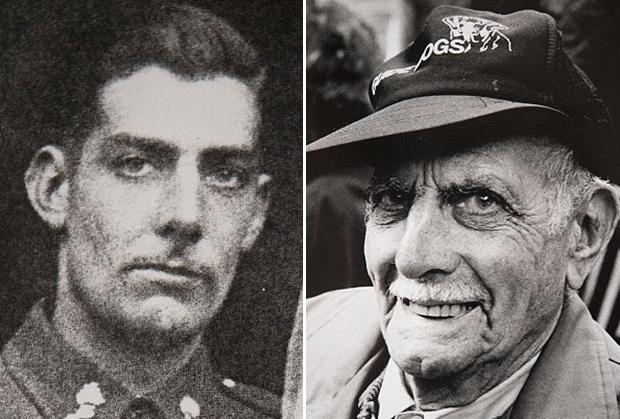
War veteran Geoffrey Bacon
|
Once upon a time, Britain was a place of law and order. Problems arose circa 1970, though marginal by comparison with the falling standards and political excuses of today. The tragic fate of ninety year old Geoffrey Bacon was one of the recent instances illustrating the decline. During the Second World War, Bacon served as a chauffeur in France. At the age of 90, he was still independent, living alone in a second floor flat in Camberwell, a suburb of south London. He had a reputation for social benevolence. In April 2010, he was attacked on his own doorstep by a mugger who threw him to the floor and punched him in the face. The victim was also kicked. The savage intruder ransacked the flat, stealing the old man's wallet containing £40 and a bus pass. The victim was left in agony with a shattered hip. He never recovered, dying a few months later; the molestation was classified by police as murder.
Detectives expressed their belief that the killer of Geoffrey Bacon was also responsible for another mugging "half an hour later in a neighbouring block of flats, where he hit a disabled woman of 66 about the head with her handbag before running off with it" (N. Sears and P. Bentley, "Killed for £40 and a bus pass," Daily Mail, 19/08/2010, pp. 1, 4). See Eisenhower's driver and Murder hunt after war veteran dies.
A decadent society too often laughs at complaints about television violence and bad language. Many people justifiably reason that such lax standards are an incitement to social delinquency. The popular BBC programme EastEnders has been known to depict a boy of 13 being knifed by a gang. A Channel 4 distraction in 2009 exhibited 312 swear words in 103 minutes. The newspaper employing this information artlessly included an irrelevant cartoon showing an old lady indignant at nudity on the tv screen, while the main feature on the same page displayed a component of the "fashion bible" Vogue, the admired young yuppy subject being pictured in his £5 million home (Daily Mail, 19/08/2010, p. 3). These distractions were found on the preceding page to urgent details about the murdered Geoffrey Bacon. A carelessly affluent society is not the best guide to living priorities.
British citizens have to survive the undeclared hazards and nonsense provided by the media and politicians, plus the increasing menace from criminals who are given easy treatment in high places. The farcical phrase Great Britain decodes to the Afflicted Little Island, reduced to a severely crippled plight by bloodsucker commercial interests, myopic political policies, and failed education.
November 2010 |




.jpg "Sid vicious 2")