|
18. THE ZOROASTRIAN CENTURIES
You acquired an unusual interest in Zoroastrianism. Why is this?
18.1 Mary Boyce and the Yazd Locale
I first began to study the subject seriously in 1979, when I purchased a new book by Professor Mary Boyce entitled Zoroastrians: Their Religious Beliefs and Practices (1979). Although this volume was intended for general circulation, the author’s familiarity with the subject was evident. I had earlier been informed about the Yazd locale of Irani Zoroastrians as a result of my researches into the background of the “Indian” mystic Meher Baba (1894-1969), whose Zoroastrian parents both came from this territory in Central Iran. However, the contributions of Professor Boyce added new dimensions to Zoroastrianism; my interest was strongly caught and sustained. Indeed, I have to acknowledge an influence of the late Mary Boyce (1920-2006) upon my amateur studies in Zoroastrianism. I did not always agree with her conclusions and method of exegesis, but her importance in this field is not in question for me.
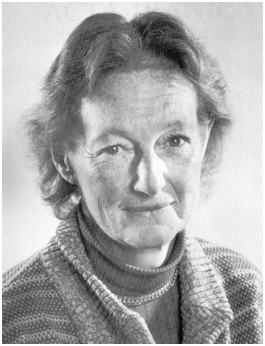
Mary Boyce
Mary Boyce was active at London University, where from 1963 she was Professor of Iranian Studies in the School of Oriental and African Studies. She trained under the Iranist Walter B. Henning (1908-67), author of the provocative work Zoroaster, Politician or Witch Doctor? (1951). Studies in Zoroastrianism gained a repute for widely diverging opinions, especially in terms of the origins of the ancient religion in focus. "Boyce is known as one of the chief campaigners for an earlier date for the prophet [Zarathushtra] than the previously common sixth century dating" (John Hinnells, "Boyce, Mary," 2010, Encyclopaedia Iranica online).
Boyce was described in one learned review as the Cinderella of Iranian Studies. Some Iranist scholars felt that the subject of Zoroastrianism was languishing and in need of new directions. During 1963-4, Boyce undertook fieldwork at the Yazd plain (in Central Iran), investigating the Zoroastrian villages which had survived there over centuries, especially Sharifabad. This outing became the pivotal factor for a new interpretation. In 1975 she delivered lectures at Oxford University on that fieldwork; these were later published as A Persian Stronghold of Zoroastrianism (1977).
Her magnum opus was A History of Zoroastrianism (1975-91). The three published volumes of that work cover the prehistoric period, the Achaemenian era, and the period under Macedonian and Roman rule. She was working on the fourth volume during her last years, relating to the Parthian era, which preceded the Sassanian rule. Amongst other works, she also contributed the anthology Textual Sources for the Study of Zoroastrianism (1984).
Boyce parted from reliance upon the purely philological method favoured in the Western academic study of Zoroastrianism. She presented this religion in terms of a continuum over the centuries, emphasising details discovered in her fieldwork. There were some criticisms of her approach from specialist rivals. However, a number of other scholars were amazed at how Mary Boyce transformed the perspective on what is basically a very difficult subject, meaning the obscure Zoroastrian centuries prior to the Parsis of India. This is a field of learned journals and some very erudite books taxing the resources of any reader outside the Iranist fold. Iranologists include multi-lingual experts of a formidable category.
18.2 Iranis and Parsis
The 1960s fieldwork of Professor Boyce gained coverage in A Persian Stronghold of Zoroastrianism (1977), describing the rural Zoroastrianism of the Yazd locale. In this book and related articles, she conveys a picture of the adverse conditions imposed upon the oppressed minority in Islamic Iran. The Zoroastrians inhabited the villages surrounding the desert city of Yazd, a remote rural area facilitating an unobtrusive profile. This minority were officially tolerated by Islam, yet despised as infidels. Petty harassments and more serious afflictions occurred. The more belligerent Muslims could spark trouble.
Long ago, Zoroastrians had been driven out of the cities and towns, their plight being one of poverty. Yazd and Kirman were sites of residual Zoroastrian life, eclipsed by Islam. On the Yazd plain, they eked out a rudimentary existence. They were not even permitted to build wind-towers for the purpose of cooling their houses during the very hot summers. This was a symptom of the intolerance meted out to the victims by the presiding ulama. The legal system of Shia Islam was loaded against the minority. The penalty for killing a Muslim was certain death. Whereas the penalty for killing a Zoroastrian merely entailed a modest fine that is said to have been habitually waived by the presiding legalists.
The Zoroastrians were forbidden by Islamic law to build their houses to any great height. The severe pressure of circumstances meant that they were in the habit of living in networks of subterranean rooms for basic purposes of defence. As a consequence of such afflictions, many of the oppressed community emigrated to India, both during the Mughal era and in British colonial times.
Zoroastrians were despised as guebres (fire-worshippers) by the Shi'ite ulama. The ineffective legalism, biased in favour of the majority, meant for Zoroastrians "a constant threat of hooligan attacks, with robbery, rape, and sometimes murder." Quotation from Boyce, Zoroastrianism: Its Antiquity and Constant Vigour (Columbia Lectures on Iranian Studies No. 7, Mazda Publishers 1992), p. 158. The oppressed minority were also subject to demands for unpaid forced labour, a situation associated with Isfahan during the Safavid era. The hideous event of forced conversion in 1699, at that same city, involved "extreme brutality," informs Boyce. "Yazdi tradition tells of the river of Isfahan running red with the blood of stabbed and mangled [Zoroastrian] corpses" (ibid). Moreover, the community of Zoroastrians at Isfahan "was obliterated in a single day" (ibid).
The lore about toleration, extended to "people of a Book," is contradicted by such events as the forcible mass conversion of Zoroastrians at the village of Turkabad in the mid-nineteenth century (ibid). Islam of the ulama meant fear and terror to the victims. No wonder that many of them departed for India.
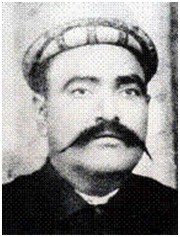
The Irani exodus was a basic theme of my own monographs appearing in the book From Oppression to Freedom (1988). That work describes a sixteenth century migration of the Zoroastrian ishraqi school associated with Azar Kaivan, and also a nineteenth century Yazdi sequel in the person of Sheriar Mundegar Irani (1853-1932). The latter escaped an afflicted rural existence near Yazd by becoming an atypical dervish; he remained a Zoroastrian until the end of his life.
Sheriar Mundegar Irani (Poona, 1890s)
The earlier migrations from Zoroastrian centres in Iran had resulted in the Parsi community of Western India. From the eighteenth century onwards, immigrants were known as Irani Zoroastrians, not Parsis. These newcomers were closer to their ethnic roots than the more admixed Parsi community, which had commenced in the ninth century, when a small group of Zoroastrians left Iran in desperation at deteriorating conditions for their faith. The detested Islamic poll-tax (jizya) was exacted from non-Muslims, a procedure liable to involve public humiliations. Moreover, the general disdain for Zoroastrians in their homeland could easily precipitate mob violence in the cause of conversion.
While Parsis spoke the Indian vernacular language of Gujarati, many Iranis spoke Dari, a distinctive Persian dialect known only to themselves. Iranis generally had a bigger physique than Parsis, according to some reports. It is also on record that Iranis were fairer in complexion and exhibited sharper facial features. Parsi genetics and customs had assimilated Hindu elements. The tales of harassment which the Iranis brought with them to India were a matter of great concern to the Parsis, who had found freedom and prosperity in their new environment.
The Iranis were direct descendants of the Sassanian population existing prior to the Arab invasion of Iran in the seventh century CE. Reconstruction of the Sassanian era is a scholastic feat, with disputes and uncertainties in evidence. Some details are firm, though many others are provisional and attended by alternative versions. Earlier eras are even more obscure.
18.3 Zarathushtra and Elusive Context
The Boyce paradigm urged an early date for the Iranian prophet Zarathushtra, who is often referred to by his Greek-associated name of Zoroaster, deriving from Zoroastres. The non-Iranian substitute has been heavily supported by convention. The original Avestan name is attended by intricate linguistic considerations; this name was much later rendered in Persian as Zartusht. The Avestan texts, dating to different periods, include the poetic Gathas traditionally attributed to Zarathushtra.
The Greek legends and accounts are an ingredient of the textual complexities. Greek writers like Plutarch ascribed the Iranian prophet to circa 6000 BCE. Other classical sources assess his date in terms of six hundred years before the Persian monarch Xerxes (i.e., meaning 1080 BCE). The Greek computations are generally viewed as misunderstandings by modern scholars. However, the worst errors in “Greek gossip” occurred when Zarathushtra was conceived as the inventor of magic, a belief gaining currency by the first century CE (via Pliny). The Iranian figurehead was also credited by Greeks with astrological compositions; this was another fiction deriving from hindsight.
Professor Boyce was quite independent from Greek sources in her insistence upon an archaic date of circa 1500 BCE for the founding prophet. At first she couched this radical assessment in terms of 1700-1500 BCE (Zoroastrians, 1979, p.18). She was referring to a Stone Age environment. This disclosure shocked partisans of the “traditional date” of circa 600 BCE, and even some of those who favoured an earlier dating at circa 1000 BCE. The lower or “traditional” date was urged by Professor Walter B. Henning in his Zoroaster, Politician or Witch-doctor? (1951).
Boyce subsequently hardened her dateline to c.1200 BCE, which proved more generally acceptable to those analysts who favoured an earlier dating. She wrote in 1992: “The spurious dating of Zoroaster to the sixth century BCE has been generally abandoned by scholars, after having troubled Zoroastrian studies for over a hundred years” (Antiquity and Constant Vigour, p. xi). A few investigators still feel that Boyce might have been correct in her dramatic Stone Age allocation prior to being influenced by the strong opposition.
The obscure prophet is represented by legendary materials in the Pahlavi language. Boyce assigned his elusive homeland to Central Asia. Differing areas are feasible in that sprawling geographical zone. Various theories relating to the dateline and homeland have appeared in the scholastic literature. It is unwise to promote any dogmatic version of this matter. My own treatment of Zarathushtra accordingly spread between different theories, including that of Boyce (Minds and Sociocultures Vol. One, 1995, Part Two). Other theories mentioned in that work were supplied by scholars like Professor Gherardo Gnoli (1937-2012).
An erudite contribution came from Gnoli in his book Zoroaster’s Time and Homeland (1980). Gnoli favoured Sistan as the homeland; he was much less radical than Boyce in regard to dating, favouring a location in time not later than the eighth century BCE, possibly earlier. Gnoli subsequently argued for a conservative dateline in relation to the prophet. See Gnoli, Zoroaster in History (2000), here reverting back to the traditional date of “258 years before Alexander” that is associated with Professor Henning, the mentor of Boyce and another very accomplished Iranist. Objections were lodged in A. Shahpur Shahbazi, “Recent speculations on the ‘traditional date of Zoroaster,’ ” Studia Iranica (2002) 31(1):7-45. Gnoli subsequently contradicted Professor Shahbazi in a related discussion of the Byzantine historian Agathias, who utilised Sassanian and other records. See Gnoli, "Agathias and the Date of Zoroaster" (2004).
The origin of the traditional date has been traced to Greek attributions assimilated by the Zoroastrian priesthood (Boyce, Antiquity and Constant Vigour, p. 20). The fluent calculation of “258 years before Alexander” is often viewed as a limitation of hindsight.
Plausible arguments place him (Zarathushtra) anywhere from the 13th century BCE to just before the rise of the Achaemenid empire under Cyrus II the Great in the mid-6th century BCE, with the majority of scholars seeming to favour dates around 1000 BCE, which would place him as a contemporary, at least, of the later Vedic poets. (William W. Malandra, “Zoroastrianism: Historical Review”, 2005, Encyclopaedia Iranica online)
The elusive homeland of Zarathushtra is named in the Avesta as Airyanem Vaejah. All attempts to trace this factor, in a geographical context, are so far considered tentative by the consensus of scholarly opinion. Earlier theories about Media (in West Iran) have dropped from favour. Media is not mentioned in the Avesta, and nor are the Medes or Persians, these being tribal communities of the Western sector. Current suggestions relate to Eastern Iran and Central Asia (a huge territory including Afghanistan), the list here encompassing Bactria, Khwarezm, and other regions. Many antique place-names cannot be found on modern maps.
Professor Boyce favoured the steppelands of Central Asia, noted for archaic sites exhumed by Soviet archaeologists. The phase she indicated was prior to the migrations onto the Iranian plateau. The Gathas are said to describe a pastoralist society of priests and herdsmen (or farmers). Fixed settlements are implied for the way of life involved in a “pre-nomadic period.”
18.4 Sintashta and Arkaim
The Boyce theory of origins focused upon Kazakhstan, an extensive area of steppe, desert, forest, and mountain. More specifically, Boyce gave attention to the Sintashta culture in northern Kazakhstan, an archaeological complex dating to the second millennium BCE. “In general the material remains of the Sintashta people, and the indications which these yield about their social and religious life, accord remarkably well with the relevant facts which can be gleaned from the Gathas” (Boyce, Antiquity and Constant Vigour, p. 37).
Her reconstruction of Old Avestan society presents Zarathushtra in objection to cattle-raiding war bands. The afflicting “non-herdsmen” are implied as renegades from the appropriate code of life emphasised in the Gathas with much allusion. The new technology of bronze weapons was acquired by steppe dwellers from cultures to the south; the pastoral way of life was threatened by the emerging class of warriors. The war chariot became a prominent feature of early Iranian life, apparently first with two horses and later with four. Social conditions changed greatly with the migrations southward that are stipulated. The nuances of Gathic terminology permit intricate interpretations of various concepts. Disagreements have occurred amongst exegetes.
In relation to Zarathushtra, "the possible chronological limits thus appear to be c.1500-c.1200” (ibid:45). Boyce here obliged critics by opting for the lower limit, which misses the time scale for Sintashta. Her initial “shock” chronology of c.1700 does fit the conventional Sintashta dating of c.2000-1600 BCE. The Sintashta site is also assessed at c. 2100-1800 BCE.
Sintashta was a large fortified settlement in the steppelands east of the South Ural mountains. The site was excavated from 1968 onwards. Sintashta is strongly associated with the sprawling Andronovo culture of Eurasia, as this part of Russia is known. Sintashta and Petrovka were earlier than classical Andronovo culture, and exhibit some differences. Clusters of sites are associated with these names. Russian archaeologists dubbed the Sintashta complex as the “land of towns.” An argument occurred amongst specialists as to whether these early sites could be identified as Proto-Indo-Iranian, with all the significances of linguistic genesis appended. One trend of interpretation has been to justify the pro-argument by the appearance of the chariot.
Some Sintashta and Petrovka graves contain the remains of chariots, thus rivalling developments in the Near East. Cattle, sheep, and horses were reared in this society, the cattle being preponderant. There are over twenty settlements identified as Sintashta-Petrovka culture. They were inhabited by metalworkers and other esteemed classes. Cattle herders have to be accounted for. Copper mining and bronze metallurgy reached an intensive stage, unusual for steppe populations. Horse sacrifices were in favour. Such sacrifices resemble funerary practices described in the Rig Veda. The theory of an early Indo-Iranian society in these settlements is feasible. However, Sintashta was not necessarily a purely Aryan site. See Elena E. Kuzmina, The Origin of the Indo-Iranians, ed. J. P. Mallory (Leiden: Brill 2007).
The social organisation of Sintashta-Petrovka culture is a matter for detailed archaeological reconstruction. The bulk of the population were probably herders living in tents, contrasting with the elite classes and craftsmen dwelling in the fortified settlements. The pastoralists have been described as "Pre-Proto-Indo-Iranian speakers," while the elite minority groups may have gradually incorporated Uralic features of pronunciation. The linguistic theories are not always definitive. However, we may believe that "the steppes were probably largely Iranian-speaking in the first and second millenia" BCE (quote from Carlos Quiles, Eurasian steppe dominated by Iranian peoples, 2018).
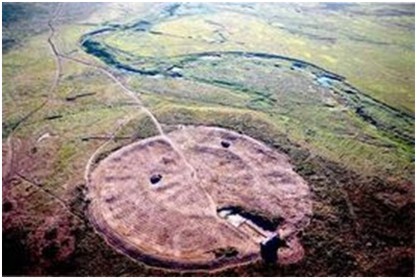
The Arkaim settlement
A major discovery occurred in 1987, when the Arkaim site came into focus. This fortified circular settlement is near Sintashta, but in a much better state of preservation. Arkaim is located in the Chelyabinsk Oblast of Russia, north of the Kazakhstan border. The distinctive site has been dated to the seventeenth century BCE. The overall urban complex is sometimes known as the Sintashta-Arkaim culture.
Arkaim had two protective and massive circular walls; the dwellings inside were grouped around a central square. The site is about 150 metres in diameter. According to archaeological assessment, the number of inmates at Arkaim was about 1500 to 2500. Those statistics mean a town by the standards of the period. Outside the walls were arable fields irrigated by a system of canals. See further K. Jones-Bley and D. G. Zdanovich, eds., Complex Societies of Central Eurasia from the 3rd to the 1st Millenium BC (2002).
The Arkaim settlement has aroused diverse speculations, including identity as a military site or a religious centre. Arkaim gained a reputation for being the most enigmatic archaeological site in Russia. Various fantasies and exaggerations developed, with some nationalist claims. Zarathushtra became a component of belief. See Archaeology and Ethnic Politics. The idea of an astronomical observatory is perhaps typical of the appetite for sensational themes. One may be open to the more sober idea that Arkaim represents an early Proto-Indo--Iranian society of elite and pastoralists. A possibility is that Arkaim was a cattle-breeding farm; this prospect does not amount to a cult centre, providing activity far removed from a military site. See Early State of the Bronze Age: Arkaim-Kargaly Case Study (2016).
The Sintashta-Arkaim culture could have been the Avestan homeland known as Airyanem Vaejah. Zarathushtra might have lived in one of the many settlements created by that culture. A cattlebreeding milieu is reflected in the Gathas.
18.5 Continuum of Religion Theory
The continuum theory of Professor Mary Boyce was startling for rivals. She argued that the remote Irani community on the Yazd plain was a more applicable focus for the beginnings of Zoroastrianism than the speculations of Western scholars. She emphasised oral tradition, employing a semi-anthropological argument that ancient practices are preserved more closely in non-literate societies than in literate ones. She was implying, amongst other things, that the beliefs and practices of contemporary Irani Zoroastrians were relevant for the interpretation of ancient texts such as the Gathas attributed to Zarathushtra. She urged that Zoroastrianism had been an oral tradition for about fifteen centuries until the Sassanian priesthood innovated written scriptures.
Boyce emphasised the continuity of ritual elements to a marked degree. According to her, the traditional Zoroastrian ritual devotions can be traced back to Zarathushtra himself, and thus back into pre-Zoroastrian times. She resisted an interpretation that the priesthood had reverted to pagan practices and neglected the purist teaching of the prophet. The contested interpretation was associated with Protestant Christianity. However, it is possible to question the primacy of ritual elements without the slightest degree of influence from Protestantism, and without necessarily converging directly with any of the exegesis to which Professor Boyce was opposed.
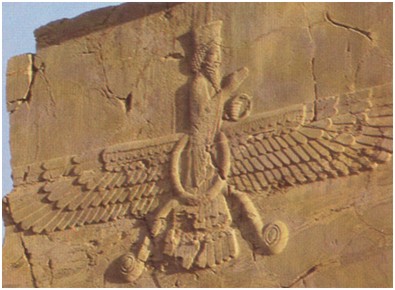
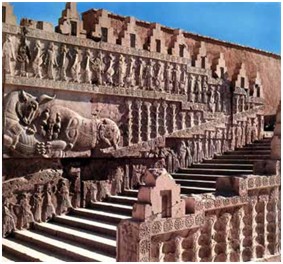
Ancient Zoroastrian icon at Persepolis
The chronological gap in scholarly interpretation amounts to six centuries or more. Boyce notably dismissed the computations of the ancient Zoroastrian priesthood, who contributed the “traditional date” for Zarathushtra in their receptivity to Greek speculation. She inferred that the priests adopted Greek fiction to fill a vacuum in their own exegetical tradition.
Did the priests get anything else wrong? They were dependent upon legends of the prophet just as contemporary scholars are. Those legends are not comprehensive biography any more than are many of the Sufi hagiographies of later Iranian centuries. The legends cannot be dismissed, nor can they be relied upon as an index to basic events. Professor Boyce frequently resorted to the legends. However, her version of the prophet’s life, in the first volume of her magnum opus, is very sophisticated by comparison with some earlier efforts in the literature.
Many of the later priests no longer knew the meaning of the texts they recited. That form of illiteracy is not the best guide to archaic events. Boyce was anxious to uphold the beliefs of the Parsi priests in her sympathy for their religion. That method does not guarantee any direct convergence with beliefs of the earliest Zoroastrian priests or the prophet Zarathushtra. The context and meaning of the Avestan texts known as Gathas is still subject to strong arguments on a number of points. Boyce opposed the “entirely novel” ritual interpretation of a learned French duo (Antiquity and Constant Vigour, p. 64).
Three major versions of the Gathas were published in translation during the years 1959-91, all by erudite scholars, and each one very different to the others. Boyce rejected all of these interpreters with the reflection that their “main concerns have been linguistic, and whose interest in Zoroastrianism has been accordingly incidental and limited” (ibid:63). In contrast, the industrious Humbach translation was approved by a fair number of other Iranists. Boyce lamented: “He (Humbach) interpreted most of the hymns as being themselves ritual texts, even though they are arranged by metre and have no discernible liturgical pattern” (ibid:64). Cf. H. Humbach, The Gathas of Zarathushtra (2 vols, 1991), a new English version of the earlier German translation published in 1959. See further Zarathushtra and Zoroastrianism.
Boyce briefly suggested a mystical orientation in the prophet, without being too definitive. That aspect of interpretation was at odds with a prevailing Western conception of the “non-mystical” this-worldly Zarathushtra. The latter conception was borrowed and preferred by twentieth century Parsi high priests like Dastur Maneckji Dhalla (1875-1956), an ecclesiastic who obtained a Western academic education in America. His History of Zoroastrianism (1938) has been viewed in the light of a Parsi Protestantism. Dhalla condemned ritual in the reformist manner disliked by Boyce, but was not venturesome in other aspects of his exposition.
There was no continuation of Zoroastrianism in Friedrich Nietzsche, despite his famous literary curiosity entitled Thus Spake Zarathustra.
18.6 Achaemenian Liberalism and the Kirder-Mani Rivalry
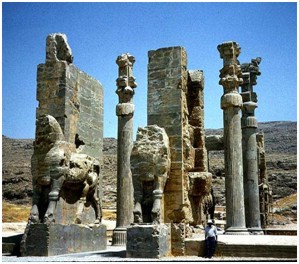
To return to the basic question of why I took such an interest in Zoroastrianism. The basic answer is because of the challenge posed by the investigation and charting of complexities, as indicated above. I had always wanted to probe deeper into that religion. The theme of religious continuation, or a contrasting transition, is only one aspect of the data. There are many purely cultural dimensions of the type which often fascinate spectators of sites like Persepolis, the royal city and palace complex in Fars, created by Achaemenian monarchs from the late sixth century BCE. The craftsmanship in stone is of a high standard, the result of artisan labour recruited from all over West Asia and the Mediterranean, including Greek craftsmen.
Persepolis
According to Boyce, all the Achaemenian kings were Zoroastrians, beginning with Cyrus the Great. Those monarchs are certainly noted for their tolerance of religious beliefs amongst subject peoples, contrasting with the more insular situation, later arising in Sassanian Iran, associated with the high priest Kirder (Kartir). Persepolis was destroyed in 330 BCE by the greedy Macedonian army of Alexander the Great. Several generations earlier, the Persian king Xerxes had attacked Athens and burned Greek temples. Zoroastrianism survived the killing and looting which ended Persepolis.
The name of Kirder has strong associations with the Sassanian empire, commencing in the third century CE and lasting until the Arab invasion. The high priest Kirder figured in what is surely one of the most evocative confrontations in the history of religion. Kirder’s opposition to rival religions included his antipathy for Mani, likewise a third century figure and still very imperfectly known. The subsequent Manichaean religion has presented many difficulties for scholarship; the learned literature on this subject is formidable. Professor Boyce tended to side with Kirder against Mani in certain of her expressions. This stance seemed unduly partisan to me, evoking a contrasting approach (Shepherd, Minds and Sociocultures Vol. One, 1995, pp. 350ff). Mani lost in this conflict, dying in a Sassanian prison, his followers being persecuted. |